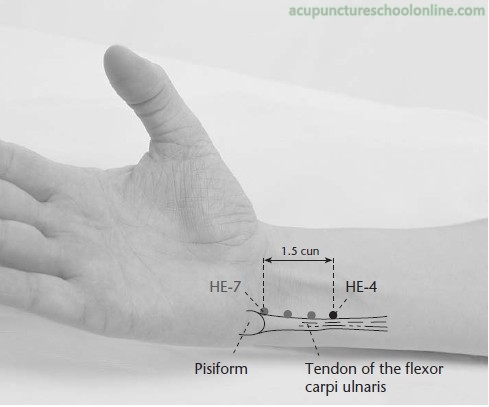
 |
Location Guides: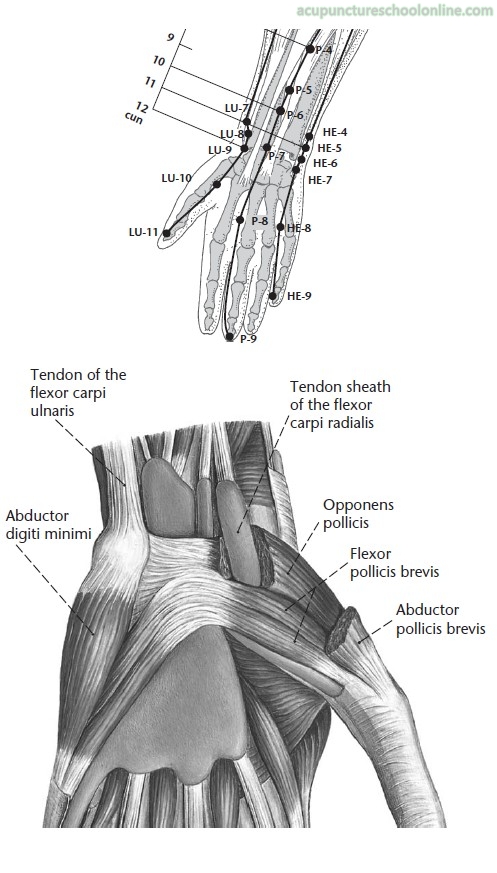 |
Jing-River and Metal Point
On the radial side of the tendon of flexor carpi ulnaris, 1.5 cun proximal to Shenmen He-7
Perpendicular insertion 0.3 - 0.5 cun, or oblique proximal or distal insertion 0.5 - 1 cun
"The Shaoyin usually has little Blood and much Qi" (Su Wen 素問 ch. 24) implying this channel should normally be needled.
"The hand Yin and Yang receive their Qi via nearby paths so their Qi arrive swiftly. The depth of piercing must not exceed 2 fen and must not remain inserted for longer than one exhalation" (Ling Shu 靈樞 ch. 12).
"It is needled to a depth of three fen and moxaed with three cones" (Huangfu Mi 皇甫謐, 3rd Century, Zhenjiu Jiayi Jing 針灸甲乙經).
Calms the Shen and benefits the voice
Relaxes the muscles and sinews
Shared with Shaoze SI-1 and balanced by ䷦ (Taixi Kid-3 or Weizhong Bl-40).
Hexagram attributions are my own with an explanation given in the glossary.
Superficial Innervation: Medial cutaneous nerve of the forearm from C8 - T1
Dermatome Segment: C8, T1
Deeper Structures: Ulnar nerve from C8 - T1
Heart 4, 5, 6 & 7 are all so close together they are usually attacked together with a grab causing great Qi loss and immobilisation, just before a more dangerous attack.
Injury here adds Fire to the Heart and causes high blood pressure immediately (Montaigue, Dim Mak Locations, Taijiworld.com).
Ling Shu Ch. 6 suggests piercing the Jing points of the Yin channels if a disease is in the Yin of the Yang realm (e.g. the sinews and bones). This would mean using this point to treat disorders of the shoulder, elbow and wrist.
Ch. 7 then suggests using paired needles either side of the tendon to remove a tendon blockage illness, and straight needling to the bone for bone blockage illness. This could be interpreted as using these technique on this point, on either side of the flexor carpi ulnaris in incidences of injury to this tendon or straight in cases of bone injury, or using these as local techniques to remove the blockage while Ch. 6 is a distal point suggestion.
Basic information on location, needle depth, TCM actions, indications and combinations is taken from Deadman et al (2001): A Manual of Acupuncture with additional anatomical information researched by reference to Gray's Anatomy (38th Ed., 1995) unless otherwise referenced. Images were found on acupunctureschoolonline.com and can be traced back to Claudia Focks (2008) Atlas of Acupuncture originally. I cannot claim any credit or rights over them. Other sources should be quoted in the text.
For some of the more unusual terms I have created a glossary here
Woodley Bioenergetics
90 Deane Croft Road,
Eascote, Pinner, Greater London. HA5 1SP
Tel/WhatsApp: +44 (0) 7946 174 829
Email: steve@steve-woodley.co.uk