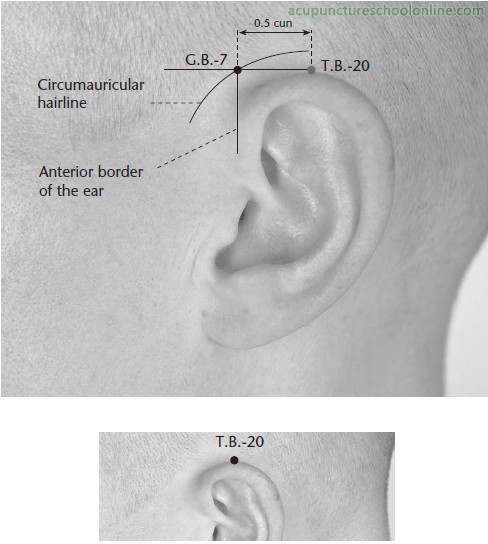
 |
Trigger point (Travell & Simons, 1998, Trigger Point Manual)
Meeting of Gall Bladder with Bladder
In the temporal region, within the hairline, level with and one finger-breadth anterior to Jiaosun SJ-20.
Transverse insertion 0.5 - 1.5 cun in the direction of symptoms or to connect with other points.
"The Shaoyang usually has little Blood and much Qi" (Su Wen 素問 ch. 24) implying this channel should normally be needled.
"The foot Shaoyang is to be pierced 4 fen deep and remain inserted for five exhalations" (Ling Shu 靈樞 ch. 12).
"It is needled to a depth of three fen and moxaed with three cones" (Huangfu Mi 皇甫謐, 3rd Century, Zhenjiu Jiayi Jing 針灸甲乙經).
Eliminates Wind and benefits the mouth and jaw
Superficial Innervation: Auriculo-temporal nerve from posterior division of mandibular branch of trigeminal nerve (CN V3)
Dermatome Segment: CN V3 mandibular branch of trigeminal
Muscle:
Temporalis
Pain Referral Pattern:
To temporal region and upper molars and jaw
Indications:
Headache and toothache with no restriction in jaw opening
; Feeling teeth do not meet right
See Montaigue, Dim Mak Locations, Taijiworld.com for explanation of effects.
Besides being a simple anatomical description, the second character is comprised of 髟, "a tuft of hair" and 賓, "a visitor, a guest". The first character, 曲 represents a bend or crook, is generally seen as misfortune in ancient China which valued the "upright" (正 Zheng), included in the other definitions for this character of "wrong; not right." Combined this image is of an unwanted visitor (Pathogenic Wind) that lodges at the hairline in this location. This can be read into the double meaning behind the translation too, with a "Crook at the Temple" also meaning "an unscrupulous person residing at a place of sanctuary".
Among the Gall Bladder points of the head, there appear to be some that indicate they are special points for influencing the Zangfu and Channels, similar to the Front or Back Shu points. The meeting with the San Jiao and indications for febrile diseases for this point would make it a suitable candidate for the head-Shu for the San Jiao. Its indications for vomiting, headaches and deviation of the mouth and eye suggest Internal Wind which are the result of Liver and Kidney Yin failing to embrace the Yang, suggesting this point is specific for Lower Jiao issues.
Basic information on location, needle depth, TCM actions, indications and combinations is taken from Deadman et al (2001): A Manual of Acupuncture with additional anatomical information researched by reference to Gray's Anatomy (38th Ed., 1995) unless otherwise referenced. Images were found on acupunctureschoolonline.com and can be traced back to Claudia Focks (2008) Atlas of Acupuncture originally. I cannot claim any credit or rights over them. Other sources should be quoted in the text.
For some of the more unusual terms I have created a glossary here
Woodley Bioenergetics
90 Deane Croft Road,
Eascote, Pinner, Greater London. HA5 1SP
Tel/WhatsApp: +44 (0) 7946 174 829
Email: steve@steve-woodley.co.uk