 |
Location Guides: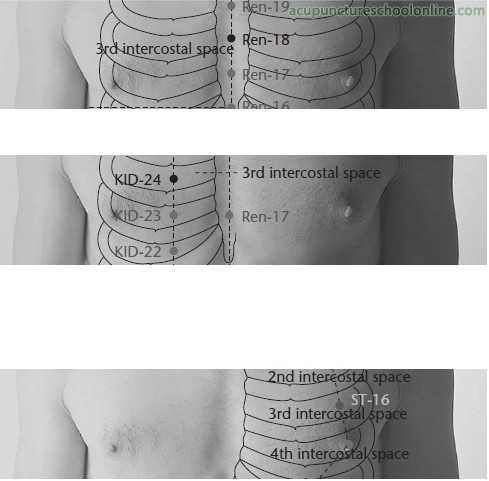 |
Front Shu of the Breast
Trigger point (Travell & Simons, 1998, Trigger Point Manual; Melzack, Stillwell & Fox, 1977)
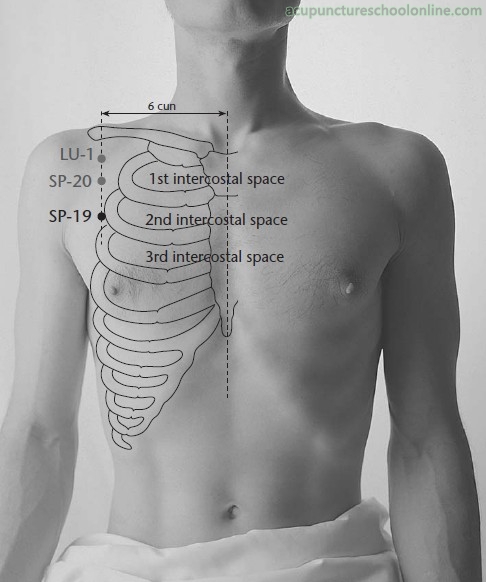
On the lateral side of the chest, in the third intercostal space, 6 cun lateral to the midline.
Transverse-oblique insertion along the intercostal space 0.5 - 1 cun
Perpendicular insertion, especially in thin patients, carries a substanstial risk of inducing a pneumothorax.
"The Taiyin usually has much Qi and little Blood" (Su Wen 素問 ch. 24) implying this channel should normally be needled.
"The foot Taiyin is to be pierced 3 fen deep and remain inserted for four exhalations" (Ling Shu 靈樞 ch. 12).
"Locate it with (the patient) lying supine. It is needled to a depth of four fen and moxaed with five cones" (Huangfu Mi 皇甫謐, 3rd Century, Zhenjiu Jiayi Jing 針灸甲乙經).
Regulates and descends Qi and unbinds the chest
Superficial Innervation: Lateral cutaneous thoracic nerve from T4 at the skin and anterior thoracic nerve (C5 - C6) to the muscle
Dermatome Segment: T4
Muscle:
Pectoralis major (costal section)
Pain Referral Pattern:
To the breast around the nipple
Indications:
Strain of pectoralis major
This point can be struck with a finger jab to weaken the opposite leg as well as great nerve damage to the shoulder area (Montaigue, Dim Mak Locations, Taijiworld.com).
One of the twelve Shu points of the breast mentioned in the Su Wen Ch. 58 and identified by Wang Bing.
Qing dynasty commentator Yue Hanzhen noted that the image of a village in the name suggests a gathering of villagers and a connection with Earth (Yue, Explanation of Channels and Points, trans. Brown, 2019, p. 193).
If the Shu points of the Breast have elemental organ associations like the Shu points of the Chest, then this imagery would suggest this is the point of the Spleen. If the theory is correct that these relate to the formation of bodily Qi from food and drink, then this point is where the Zhen Qi is formed, itself consisting of Gu Qi and Kong Qi making Zong Qi, then mixing with Yuan Qi and differentiating itself into Ying Qi and Wei Qi, a veritable village of different Qi.
Basic information on location, needle depth, TCM actions, indications and combinations is taken from Deadman et al (2001): A Manual of Acupuncture with additional anatomical information researched by reference to Gray's Anatomy (38th Ed., 1995) unless otherwise referenced. Images were found on acupunctureschoolonline.com and can be traced back to Claudia Focks (2008) Atlas of Acupuncture originally. I cannot claim any credit or rights over them. Other sources should be quoted in the text.
For some of the more unusual terms I have created a glossary here
Steve Woodley Acupuncture & Traditional Medicine
90 Deane Croft Road,
Eascote, Pinner, Greater London. HA5 1SP
Tel/WhatsApp: +44 (0) 7946 174 829
Email: steve@steve-woodley.co.uk