 |
Trigger point (Travell & Simons, 1998, Trigger Point Manual; Melzack, Stillwell & Fox, 1977)
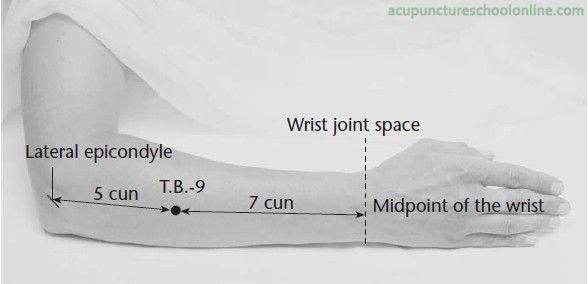
In the depression between the radius and the ulna, on a line drawn between Yangchi SJ-4 and the lateral epicondyle of the humerus, 7 cun proximal to Yangchi SJ-4.
Perpedicular or oblique proximal or distal insertion towards the elbow or wrist respectively 1 - 2 cun
"The Shaoyang usually has little Blood and much Qi" (Su Wen 素問 ch. 24) implying this channel should normally be needled.
"The hand Yin and Yang receive their Qi via nearby paths so their Qi arrive swiftly. The depth of piercing must not exceed 2 fen and must not remain inserted for longer than one exhalation" (Ling Shu 靈樞 ch. 12).
"It is needled to a depth of six fen, (the needle) is retained for a duration of seven exhalations, and it is moxaed with three cones" (Huangfu Mi 皇甫謐, 3rd Century, Zhenjiu Jiayi Jing 針灸甲乙經).
Benefits the throat and ears
Superficial Innervation: Posterior cutaneous nerve of the forearm (C5 - C8)
Dermatome Segment: C6, C7
Deeper Structures: Radial nerve (C6 - C8)
Muscle:
Extensor carpi radialis brevis
Location Notes:
A similar point on the ulnar side of the bone relates to extensor carpi ulnaris
Pain Referral Pattern:
Along radial aspect of the forearm to the dorsal aspect of the hand and lateral aspect of the elbow
Indications:
Extensor tendonitis of the forearm
; Tennis elbow pain
See Montaigue, Dim Mak Locations, Taijiworld.com for explanation of effects.
In Mayan medicine:
Used to combat shoulder pain caused by wind (Garcia, Sierra, Balam, 1999: Wind in the Blood)
Basic information on location, needle depth, TCM actions, indications and combinations is taken from Deadman et al (2001): A Manual of Acupuncture with additional anatomical information researched by reference to Gray's Anatomy (38th Ed., 1995) unless otherwise referenced. Images were found on acupunctureschoolonline.com and can be traced back to Claudia Focks (2008) Atlas of Acupuncture originally. I cannot claim any credit or rights over them. Other sources should be quoted in the text.
For some of the more unusual terms I have created a glossary here
Woodley Bioenergetics
90 Deane Croft Road,
Eascote, Pinner, Greater London. HA5 1SP
Tel/WhatsApp: +44 (0) 7946 174 829
Email: steve@steve-woodley.co.uk