 |
Location Guides: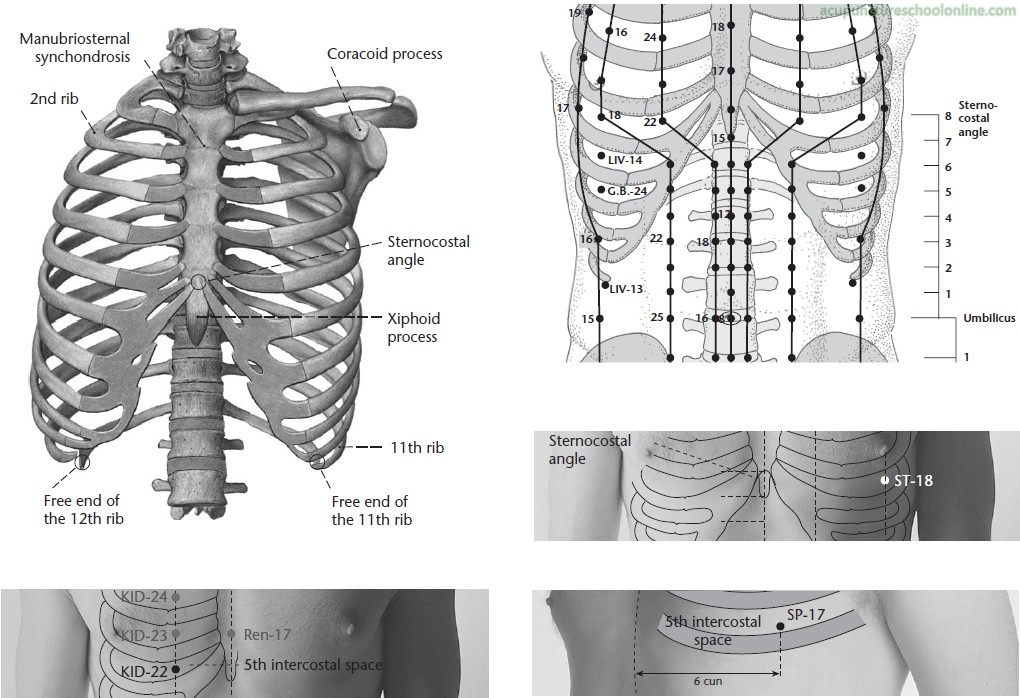 |
Binding point of the hand Jueyin Sinews
Meeting of Conception Vessel with Strength line (Zhuangli Xian 壯力線)
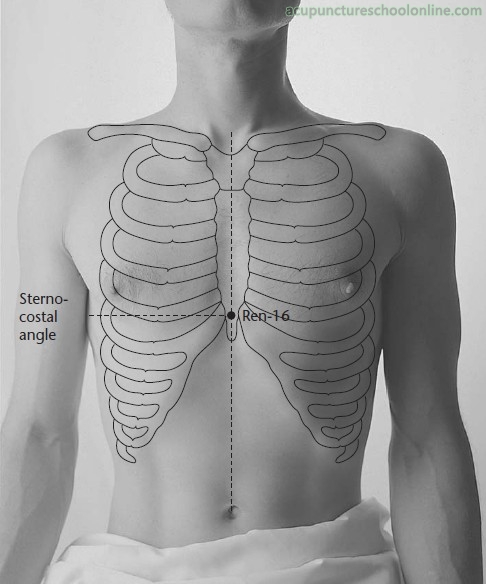
On the midline of the sternum at the sternocostal angle.
Transverse insertion, directed superiorly or inferiorly along the midline 0.5 cun
"Locate it with (the patient) lying supine. It is needled to a depth of three fen and moxaed with five cones" (Huangfu Mi 皇甫謐, 3rd Century, Zhenjiu Jiayi Jing 針灸甲乙經).
Unbinds the chest
Regulates the Stomach and descends rebellion
Superficial Innervation: Anterior cutaneous thoracic nerve from T6
Dermatome Segment: T6
This is one of the eight striking points in Northern Praying Mantis Kung Fu. These are the nonfatal areas on an attacker's body that can be struck when just defending or wanting to defeat an attacker. Described as "The point in the middle of the ribs" although the diagram shows it towards the bottom of the sternum, around this point (Olson, 2010, The Complete Guide to Northern Praying Mantis Kung Fu). Wong Honfan (1946) describes it as "the lungs under the upper ribs [the flanks]" suggesting Liv-14 or GB-24 (Ravenswood Academy, 2020, The Eight Forbidden Strikes of Praying Mantis Fist).
See Montaigue, Dim Mak Locations, Taijiworld.com for explanation of effects.
The Strength line (Zhuangli Xian 壯力線) is an internal line used in inner cultivation arts (Neigong Shu 內功術) that connects the xiphoid process at this point or Jiuwei Ren-15 with T11 at Jizhong Du-6 or Zhongshu Du-7. It is used to strengthen the tendons in the body and used more in the hard, external forms of Qigong and martial arts (Wang, 2019, Daoist Internal Mastery ).
In ayurvedic medicine:
Hridayam marma point
Size: 4 angula (cun)
Structure: Blood vessel
Effect of Injury: Fatal (sadhyapranahar marma)
(Harish Johari, 1996, Ayurvedic Massage, Sanatan Society; Anupama Bhattacharya, n.d. Marma Shastra)
In Tibetan medicine:
Moxa point (AMNH, Tibetan Medical Paintings)
Basic information on location, needle depth, TCM actions, indications and combinations is taken from Deadman et al (2001): A Manual of Acupuncture with additional anatomical information researched by reference to Gray's Anatomy (38th Ed., 1995) unless otherwise referenced. Images were found on acupunctureschoolonline.com and can be traced back to Claudia Focks (2008) Atlas of Acupuncture originally. I cannot claim any credit or rights over them. Other sources should be quoted in the text.
For some of the more unusual terms I have created a glossary here
Woodley Bioenergetics
90 Deane Croft Road,
Eascote, Pinner, Greater London. HA5 1SP
Tel/WhatsApp: +44 (0) 7946 174 829
Email: steve@steve-woodley.co.uk