|
Location Guides: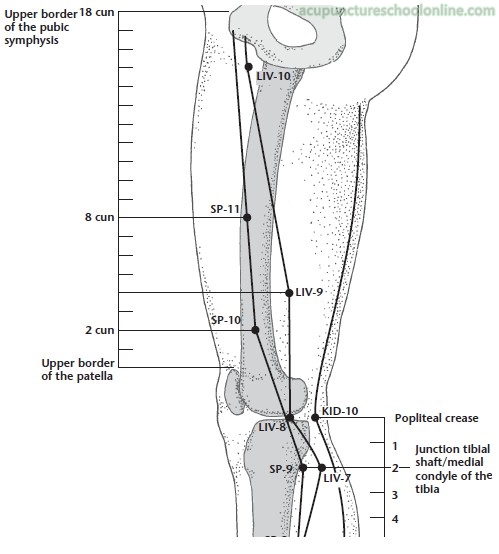 |
Trigger point (Travell & Simons, 1998, Trigger Point Manual; Melzack, Stillwell & Fox, 1977)
3 cun inferior to Qichong St-30 (2 cun from the midline level with the superior border of the symphysis pubis, Qugu Ren-2) on the anterior border of m. adductor longus.
Perpendicular or oblique insertion 0.5 - 1.5 cun
"The Jueyin usually has much Blood and little Qi" (Su Wen 素問 ch. 24) implying this channel should normally be bled.
"The foot Jueyin is to be pierced 1 fen deep and remain inserted for two exhalations" (Ling Shu 靈樞 ch. 12).
"It is needled to a depth of six fen and moxaed with five cones" (Huangfu Mi 皇甫謐, 3rd Century, Zhenjiu Jiayi Jing 針灸甲乙經).
Clears Damp-heat and benefits the Lower Jiao
Superficial Innervation: Obdurator nerve (L2 - L3)
Dermatome Segment: L3
Muscle:
Adductor longus, sartorius and psoas.
Location Notes:
Sartorius trigger point would be located slightly inferior, on the belly of the muscle.
Psoas trigger point is located lateral to the femoral artery.
Pain Referral Pattern:
Adductor longus: Radiating from the point to the hip and medial aspect of the thigh. Also radiating down the medial aspect of the leg with concentration around the upper medial border of the patella
Sartorius: Local to point along the path of the muscle
Psoas: Lower back, front of leg and groin.
Indications:
Strain of adductor muscles or sartorius muscles; Degenerative diseases of the hip
Mainly used as a set up point for a knock out strike, it causes local pain and drains Qi, putting the body into sleep mode. A hard enough strike can confuse the signals from the eyes (Montaigue, Dim Mak Locations, Taijiworld.com).
The Su Wen Ch. 20, Discourse on the Three Sections and Nine Indicators, describes "The heaven [indicator] of the lower section: the foot ceasing yin [locations]... the heaven [indicator] serves to examine the liver". Wang Bing's commentary says this means "This is to say: the liver vessels. Their movement can be felt. It should be taken while the person lies down - at the 'five miles' section in the hollow one and a half inches below the Sheep Droppings (羊矢) [piercing hole] outside the [pubic] hair line" (Huang Di Nei Jing Su Wen, trans. Unschuld & Tessenow, 2011). Wang (2019, Daoist Internal Mastery) interprets this to mean Jimai Liv-12 and this point. For women he suggests Taichong Liv-3.
Avicenna describes cupping at this point in his treatise On Cupping:
"Cupping on the upper back and inner sides of the thighs is beneficial in bloody chest disease (hemoptysis) and bloody asthma; however it weakened the stomach and causes heart palpitations." (Aspects of Treatment According to General Diseases, 22nd section in Abu-Asab, Amri & Micozzi, 2013, Avicenna's Medicine)
In Mayan medicine:
Used to treat pain in the lower limbs (Garcia, Sierra, Balam, 1999: Wind in the Blood)
In ayurvedic medicine:
Vitapa marma point
Size: 1 angula (cun)
Structure: Blood vessel
Effect of Injury: Disability (vaikalyakar marma)
(Harish Johari, 1996, Ayurvedic Massage, Sanatan Society; Anupama Bhattacharya, n.d. Marma Shastra)
Lad and Durve (2008) in Marma Points of Ayurveda call this point Lohitaksha and associate it with the doshas: Vyana Vayu, Apana Vayu, Shleshaka Kapha and Ranjaka Pitta.
They give the following functions:
- Promotes circulation in the lower extremities
- Balances apana vayu
- Relieves pain locally
- Regulates blood flow to the legs
- Benefits the heart and colon
In Thai massage:
Acupressure point called "femoral wind gate" (Salguero & Roylance, 2011, Encyclopedia of Thai Massage)
Basic information on location, needle depth, TCM actions, indications and combinations is taken from Deadman et al (2001): A Manual of Acupuncture with additional anatomical information researched by reference to Gray's Anatomy (38th Ed., 1995) unless otherwise referenced. Images were found on acupunctureschoolonline.com and can be traced back to Claudia Focks (2008) Atlas of Acupuncture originally. I cannot claim any credit or rights over them. Other sources should be quoted in the text.
For some of the more unusual terms I have created a glossary here
Woodley Bioenergetics
90 Deane Croft Road,
Eascote, Pinner, Greater London. HA5 1SP
Tel/WhatsApp: +44 (0) 7946 174 829
Email: steve@steve-woodley.co.uk