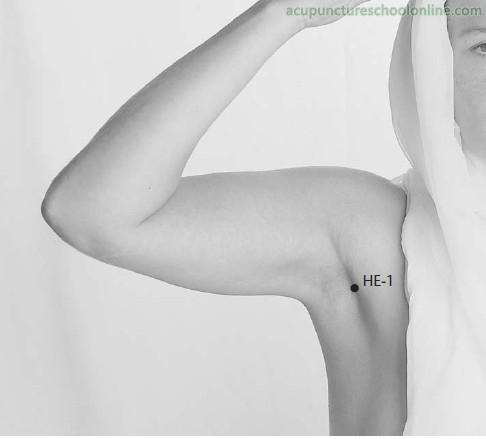
 |
Location Guides: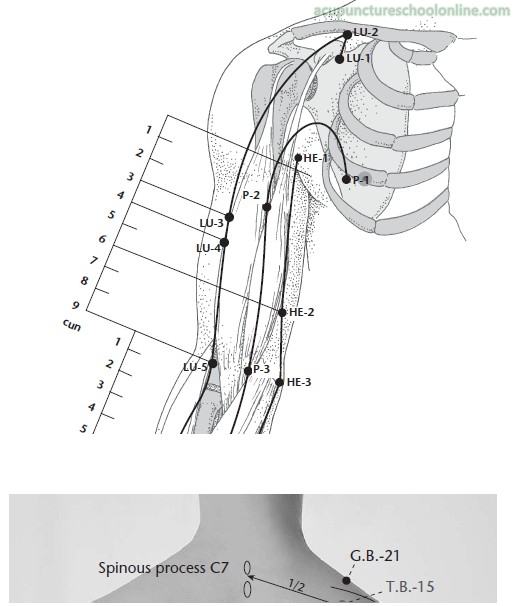 |
Entry point from Dabao Sp-21
Opening point of the Heart Divergent channel (Cecil-Sterman, 2012, Advanced Acupuncture)
Binding point of the hand Shaoyin and hand Jueyin Sinews
Trigger point (Travell & Simons, 1998, Trigger Point Manual; Melzack, Stillwell & Fox, 1977)
Meeting of Heart with Small Intestine Divergent and Heart Divergent
In the depression at the centre of the axilla
Perpendicular insertion in the direction of Jianjing GB-21 0.5 - 1 cun, avoiding the axillary artery
Medial insertion towards the chest may puncture the lung
"The Shaoyin usually has little Blood and much Qi" (Su Wen 素問 ch. 24) implying this channel should normally be needled.
"The hand Yin and Yang receive their Qi via nearby paths so their Qi arrive swiftly. The depth of piercing must not exceed 2 fen and must not remain inserted for longer than one exhalation" (Ling Shu 靈樞 ch. 12).
"It is needled to a depth of three fen and moxaed with five cones" (Huangfu Mi 皇甫謐, 3rd Century, Zhenjiu Jiayi Jing 針灸甲乙經).
Unbinds the chest
Activates the channel and benefits the arm
Superficial Innervation: Medial cutaneous nerve of the arm from T1 - T2
Dermatome Segment: T1
Deeper Structures: Insertion point of subscapular nerve (C5 - C6) into subscapularis muscle
Muscle:
Subscapularis
Location Notes:
The actual trigger points are located on the anterior surface of the scapula but can only be accessed from this point
Pain Referral Pattern:
Across scapula and concentrating on posterior aspect of the deltoid. Also radiating down across the triceps and the dorsal aspect of the wrist
Indications:
Musculoskeletal diseases of the shoulder
One of the 36 vital points of Feng Yiyuan 馮一元 listed in the Wu Bei Zhi 武備志 (Treatise on Armament Technology) by Mao Yuanyi 茅元儀 (1621) (McCarthy, 2016, Bubishi: The Classic Manual of Combat).
A medium to heavy strike can stop the heart or cause great damage to the axillary artery as well as immediate shoulder damage. It can also affect the Shen causing a feeling of disconnection from God (presumably the Tao in traditional texts), impairing brain function, mental activity, emotional state and speech (Montaigue, Dim Mak Locations, Taijiworld.com).
In seizing martial arts (Qin Na) this point is a cavity striking point (Da Xue 打穴) struck with Secret Sword hand form and causing possible heart attack (Yang, 1995, Tai Chi Chin Na; Yang, 2004, Analysis of Shaolin Chin Na, 2nd Edition).
Location of axillary pulse
Ling Shu Ch. 71, On Evil Visitors, says that when a depletion evil is in the Liver it flows in the armpits. One theory of the Divergent meridians suggests that they store pathogens at the major joints, depleting our resources to keep them sedated, which would suggest this point is associated with the Liver/Gall Bladder Divergents.
Principle Point of the Xing Nao Kai Qiao (醒脑开窍, activating the brain and opening the orifices) method of Dr. Shi Xue-Min for post-stroke sequalae along with Renzhong Du-26, Neiguan Pc-6, Sanyinjiao Sp-6, Chize Lu-5 and Weizhong Bl-40.
The aim of these points are to use the Yin meridians and the Du meridian to activate the brain and open the orifices and nourish the liver and kidney. This point dredges the channels, moves Qi and Blood, and improves the function of the limbs. Each point is usually manipulated for 1-3 minutes with one treatment course constituting 10 days of twice daily treatments 3-6 hours apart; 3-5 treatment courses are used continuously.
Liu, J. & Liu, K. (2012). Dr. Shi Xue-Min and the Xing Nao Kai Qiao Legacy. Acupuncture Today 13(3).
In ayurvedic medicine:
Lohitaksha marma point
Size: 1/2 angula (cun)
Structure: Blood vessel
Effect of Injury: Disability (vaikalyakar marma)
(Harish Johari, 1996, Ayurvedic Massage, Sanatan Society; Anupama Bhattacharya, n.d. Marma Shastra)
Lad and Durve (2008) in Marma Points of Ayurveda call this point Kaksha and associate it with the doshas: Vyana Vayu, Pachaka Pitta, Shleshaka Kapha and Avalambaka Kapha.
They give the following functions:
- Benefits the breasts
- Improves lymphatic drainage of breast tissue
- Enhances blood and lymph circulation in upper extremities
- Regulates sweating
- Relaxes shoulder and upper extremities
Sieler (2015, Lethal Spots, Vital Secrets, p.232) describes a varmam spot in siddha medicine near the armpit called kaiviralmatakkivarmam or "finger bending spot" which is activated by pinching the skin between the thumb and index finger.
In Tibetan medicine:
Moxa point (AMNH, Tibetan Medical Paintings)
In Thai massage:
Point along the Kalatharee sen line running from the navel Shenque Ren-8 to the hands (Salguero & Roylance, 2011, Encyclopedia of Thai Massage)
Basic information on location, needle depth, TCM actions, indications and combinations is taken from Deadman et al (2001): A Manual of Acupuncture with additional anatomical information researched by reference to Gray's Anatomy (38th Ed., 1995) unless otherwise referenced. Images were found on acupunctureschoolonline.com and can be traced back to Claudia Focks (2008) Atlas of Acupuncture originally. I cannot claim any credit or rights over them. Other sources should be quoted in the text.
For some of the more unusual terms I have created a glossary here
Woodley Bioenergetics
90 Deane Croft Road,
Eascote, Pinner, Greater London. HA5 1SP
Tel/WhatsApp: +44 (0) 7946 174 829
Email: steve@steve-woodley.co.uk