 |
Location Guides: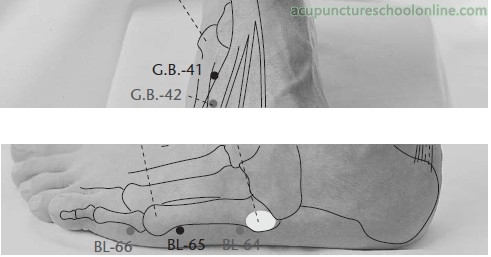 |
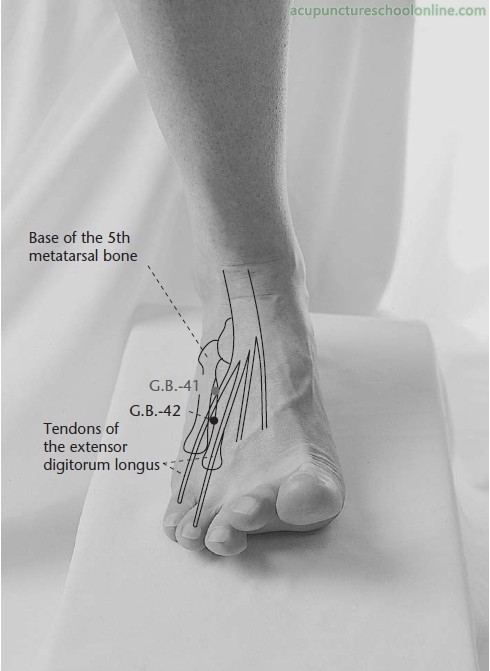
Between the 4th and 5th metatarsal bones, in the depression proximal to the metatarsal heads, on the medial side of the tendon of m. extensor digitorum longus branch to the little toe.
Perpendicular insertion 0.5 - 0.8 cun
Incorrect angle of insertion wil not enable the needle to pass between the shafts of the fourth and fifth metatarsal bones. The Systematic Classic of Acupuncture and Moxibustion, Great Compendium of Acupuncture and Moxibustion and Illustrated Classic of Acupuncture Points of the Bronze Man all say that this point should not be treated with moxibustion or emaciation and death will occur within 3 years. Modern sources agree that there is no contraindication to moxibustion at this point.
"The Shaoyang usually has little Blood and much Qi" (Su Wen 素問 ch. 24) implying this channel should normally be needled.
"The foot Shaoyang is to be pierced 4 fen deep and remain inserted for five exhalations" (Ling Shu 靈樞 ch. 12).
"It is needled to a depth of three fen, and moxibustion is prohibited since it may cause a person to become emaciated and to eventually die in no more than three years" (Huangfu Mi 皇甫謐, 3rd Century, Zhenjiu Jiayi Jing 針灸甲乙經).
Spreads Liver Qi
Clears Gallbladder Heat
Superficial Innervation: Superficial fibular (peroneal) nerve (L4 - S1)
Dermatome Segment: L5, S1
See Montaigue, Dim Mak Locations, Taijiworld.com for explanation of effects.
Despite the symbolism of "five," "earth" as the centre of the Five Phases and "Hui" as a category of meeting points, this point seems to have little that would justify this name besides some indications for swelling and patterns that could imply Damp-Heat. It is actually one of the few peripheral points that does not have an elemental or special category designation.
Instead, the name of this point is possibly derived from the fact that it is one of five Gall Bladder points located on the foot, which is near the ground (Gyawali, 2019). This point would be the centre of those five.
A similar logic could suggest this point refers to the toes as the "fivefold connection to the earth" and could open all the lower Jing-Well points but there is no indication that suggests an effect on any other channel, or releases Pathogens.
Another possibility, derived from personal clinical use, is that this point is the equivalent in location to Taichong Liv-3 on the outside of the foot, and I sometimes use instead when the person is face down and Taichong Liv-3 is difficult to access. Five is the number in the centre of the Luoshu square, representing Earth, making "Earth Five 地五" redundant terms to emphasise the connection to Earth, while Hui 會 "connect" refers to this point connecting to the Earth point on the Liver channel, Taichong Liv-3.
This is supported by Yue Hanzhen (1602-1693 CE) in whose Explanation of Channels and Points it states: "For the points on the Shaoyang channel, there are five (Wu) points located on the foot. In addition, Taichong (Liv-3) of the Liver channel has a network vessel that horizontally links it with Diwuhui (GB-42), as though a tree planting it roots in the earth (Di). As this point is the meeting (Hui) place with the Liver channel, thus it is called "Fivefold earth meeting" (Diwuhui).
This may also account for the prohibition of moxa on this point causing emaciation and death, because, by connecting to the Liver Source and Earth point, it would increase the power of Wood to suppress the Spleen and lead to emaciation and eventual death. However, this does not explain why the same contraindication is given to Taichong Liv-3, except that maybe Taichong Liv-3, being on a Yin channel, can be moxaed to nourish the Yin aspect of the Liver, whereas its equivalent Yang point will only increase its suppressive capabilities.
Renying St-9 also has alternate name of Tianwuhui 天五会, "Heaven's Fivefold Meeting" which connects it to this point. This implies that these points were originally used as a form of pulse diagnosis and that this point may have been located closer to a palpable pulse, such as the dorsalis pedis. Abnormal pulsation, colours or temperature at these points were associated with Shidong Bing 是动病, "Pulsation Disease". The Suwen ch. 46 and Ling Shu ch. 10 associates this with Yang Jue 陽厥, "Yang Reversal," where Yang Heat becomes trapped in the interior and abnormal pulsation here may be an indicator of this pattern emerging (although Su Wen ch. 46 does not state a particular point, only that "the Shaoyang Qi moves" when it ordinarily does not move here. Wang Bing thought this might refer to Tianyou SJ-16 at the rear of the SCM muscle, along with Tianrong SI-17 above the usual carotid arterial pulse as an indicator of Taiyang, as opposed to Renying St-9 where it does normally move. This may also support the contraindication of moxa at this point, as increasing internal Heat will lead to consumption of Yin and eventual emaciation and death.
Jeffrey Yuen considers this point as a remnant of an earlier shamanic tradition, and its name is in reference to practices of stomping on the ground while dancing. When standing, we connect with Yongquan Kid-1, but when dancing or stomping, we connect with the Spirit of the Earth through this point, and transmit its vibrations along the Liver channel to the pituitary and the Third Eye at Yintang and Baihui Du-20. The contraindication to treatment is said to be out of respect for this point as a point of cultivation rather than treatment. There are no written sources to corroborate this, being an oral tradition.
In Tung acupuncture this is the location of the Shui Qu, Water Score, point. It is indicated for traumatic injury where it is often combined with Liu Wan (1 cun distal, at Xiaxi GB-43), and pain, stiffness and swelling along the channel and Damp disorders (Chu, 2015).
The Tung point Mu Liu, Wood Remains, is located at the same level as this point between the 3rd and 4th metatarsal bones and indicated Shaoyang patterns including indigestion, fatigue and poor circulation, often combined with Mu Dou, Wood Combat, 1 cun distal (Chu, 2015).
In reflexology this point relates to the breast, lungs and chest.
In Thai massage:
Acupressure point (Salguero & Roylance, 2011, Encyclopedia of Thai Massage)
Basic information on location, needle depth, TCM actions, indications and combinations is taken from Deadman et al (2001): A Manual of Acupuncture with additional anatomical information researched by reference to Gray's Anatomy (38th Ed., 1995) unless otherwise referenced. Images were found on acupunctureschoolonline.com and can be traced back to Claudia Focks (2008) Atlas of Acupuncture originally. I cannot claim any credit or rights over them. Other sources should be quoted in the text.
For some of the more unusual terms I have created a glossary here
Woodley Bioenergetics
90 Deane Croft Road,
Eascote, Pinner, Greater London. HA5 1SP
Tel/WhatsApp: +44 (0) 7946 174 829
Email: steve@steve-woodley.co.uk