 |
Location Guides: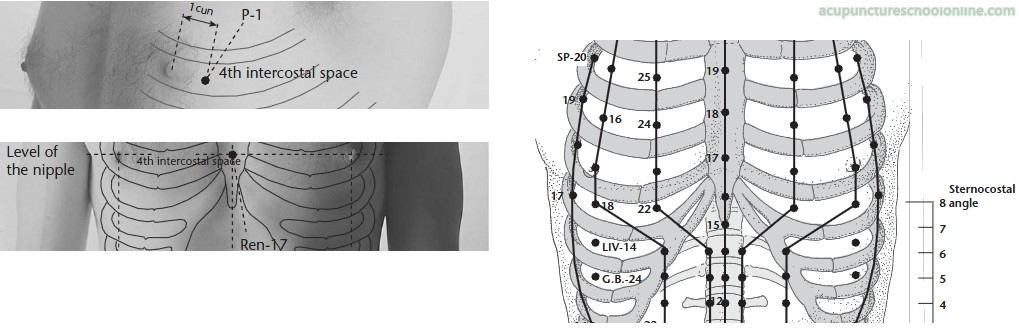 |
Great Luo of the Spleen (Nei Jing)
Confluent point of the Small Intestine and Heart Divergent channels (Cecil-Sterman, 2012, Advanced Acupuncture)
Opening point of the Pericardium Divergent channel (ibid.)
Binding point of the foot Taiyang, foot Shaoyang, foot Taiyin and hand Shaoyin Sinews
Meeting point for all arm Yin Sinew Meridians (Yuen, 2003, The Sinew Meridians: NESA).
Confluent point of the Shaoyang zone
Trigger point (Melzack, Stillwell & Fox, 1977, Trigger Points and Acupuncture Points for Pain: Correlations and Implications, Pain 3, p3-23)
Meeting of Gall Bladder with Heart Divergent, Pericardium Divergent and Lung Divergent
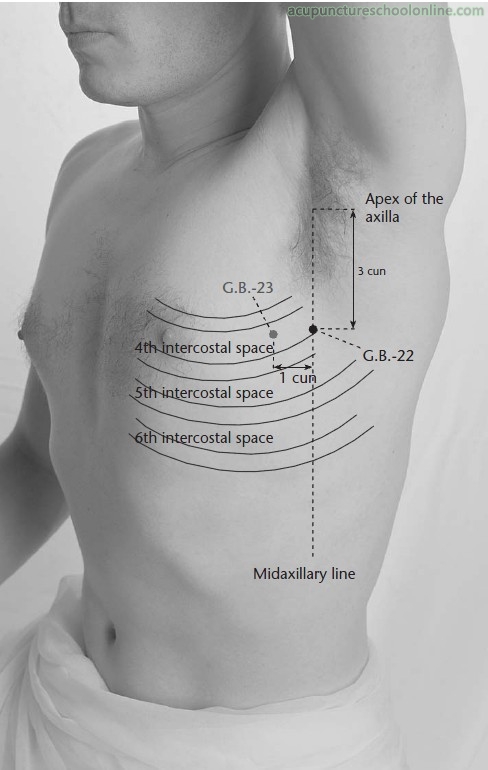
On the mid-axillary line, in the fifth intercostal space, approximately 3 cun inferior to the apex of the axilla, at the level of the nipple. Some sources locate this point in the fourth intercostal space. The Systematic Classic defines it as being in a depression 3 cun below the axilla, located with the arm raised. This most likely puts it on the border of the latissimus dorsi.
Transverse-oblique insertion along he intercostal space 0.5 - 1 cun
Deep or perpendicular needling may induce a pneumothorax. According to several classical texts this point is contraindicated to moxibustion. The Systematic Classic says it may cause swelling corrosion and saber lumps.
"The Shaoyang usually has little Blood and much Qi" (Su Wen 素問 ch. 24) implying this channel should normally be needled.
"The foot Shaoyang is to be pierced 4 fen deep and remain inserted for five exhalations" (Ling Shu 靈樞 ch. 12).
"Locate it with the arm raised. It is needled to a depth of three fen, but moxibustion is contraindicated as moxibustion may unfortunately cause swelling corrosion and saber lumps. Saber lumps which fester inward are fatal, but those due to cold and heat are curable" (Huangfu Mi 皇甫謐, 3rd Century, Zhenjiu Jiayi Jing 針灸甲乙經).
Regulates Qi and unbinds the chest
Beneifts the axilla
Superficial Innervation: Lateral cutaneous thoracic nerve from T5 or T6
Dermatome Segment: T5, T6
Muscle:
Pectoralis major (both heads) and intercostals
Location Notes:
Intercostals can produce trigger points anywhere in the intercostal space
Pain Referral Pattern:
Local to point and across chest
Indications:
Pectoral strain
; Cardiac syndromes
In seizing martial arts (Qin Na) this point is a cavity press point (Dian Xue, 點穴) which can be struck with a Phoenix Eye Fist or elbow causing possible sealing of the breath (Bi Qi, 閉氣) (Yang, 1995, Tai Chi Chin Na).
See Montaigue, Dim Mak Locations, Taijiworld.com for explanation of effects.
The Ling Shu and the Nan Jing disagree on the location of the Great Luo of the Spleen. The Nan Jing places it here while the Ling Shu places it 3 cun lower at Dabao Sp-21. This location is preferred by Ann Cecil-Sterman (2012, Advanced Acupuncture) for Luo treatments.
Basic information on location, needle depth, TCM actions, indications and combinations is taken from Deadman et al (2001): A Manual of Acupuncture with additional anatomical information researched by reference to Gray's Anatomy (38th Ed., 1995) unless otherwise referenced. Images were found on acupunctureschoolonline.com and can be traced back to Claudia Focks (2008) Atlas of Acupuncture originally. I cannot claim any credit or rights over them. Other sources should be quoted in the text.
For some of the more unusual terms I have created a glossary here
Woodley Bioenergetics
90 Deane Croft Road,
Eascote, Pinner, Greater London. HA5 1SP
Tel/WhatsApp: +44 (0) 7946 174 829
Email: steve@steve-woodley.co.uk