 |
Location Guides: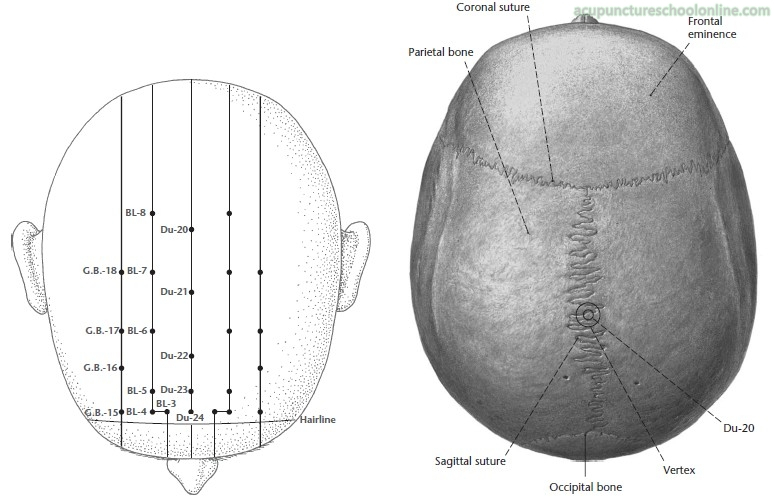 |
One of the "59 piercings" for clearing Heat in Su Wen Ch. 61
One of the Greater Four Alert Spirits (Da Sishencong) along with Houding Du-19 and Luoque Bl-8
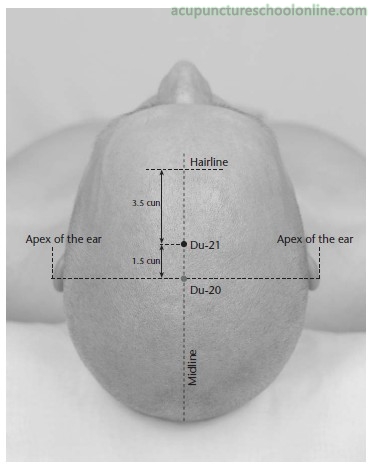
At the top of the head on the midline, 1.5 cun directly anterior to Baihui Du-20 and 3.5 cun posterior to the anterior hairline.
Transverse insertion 0.5 - 1 cun
This point should not be needled in infants whose fontanelle has not yet closed.
"It is needled to a depth of four fen and moxaed with five cones" (Huangfu Mi 皇甫謐, 3rd Century, Zhenjiu Jiayi Jing 針灸甲乙經).
Eliminates Wind and treats convulsions
Benefits the head
Superficial Innervation: Ophthalamic branch of trigeminal nerve (CN V1)
Dermatome Segment: CN V1 ophthalamic branch of trigeminal
One of the Shichen 時辰 (long hours) vital points associated with the 12 Branches in the Wu Bei Zhi 武備志 (Treatise on Armament Technology) by Mao Yuanyi 茅元儀 (1621). This point along with Shaohai He-3, Shenque Ren-8 and Huangshu Kid-16 are associated with Wei 未 Ram (1-3 pm) and if struck during this time is said to cause death within one year from trauma to the coronal suture (McCarthy, 2016, Bubishi: The Classic Manual of Combat).
See Montaigue, Dim Mak Locations, Taijiworld.com for explanation of effects.
The "59 piercings" are named in the Su Wen Ch. 61 and mentioned in Su Wen Ch. 32 for treating Heat diseases. This point along with Shangxing Du-23, Xinhui Du-22, Baihui Du-20 and Houding Du-19 clear Heat from counterflow in the Du channel.
Ling Shu Ch. 23, On Heat Diseases, gives a different set of "59 Piercings but includes 5 points on either side 3 or 4 cun above the hairline which would be to either side of this point.
Ling Shu Ch. 24, On Counterflow Diseases, seems to employs this set of points in treating headache, dizziness and heaviness of the head. It advises draining from the five points on each of the five channels on the top of the head, including this point, followed by the hand Shaoyin and then foot Shaoyin.
This point along with Baihui Du-20, Xinhui Du-22, Shangxing Du-23, Shenting Du-24 and Yintang connect with the frontal brain concerned with differentiation of experiences and is associated with the Liver, Pericardium and Yang channels (Yuen, 1995, The Curious Organs, taken from class notes by Avi Magidoff).
In Tung acupuncture this point is called Qian Hui (1010.05), Anterior Meeting, and indicated for headache, dizziness, unconsciousness, blurry vision and nerve degeneration (Chu, 2015).
Location of the Yin Wei Mai in Zhang Boduan's Book of the Eight Vessels on alchemical working (Wang Mu, 2011, Foundations of Internal Alchemy)
Among the Du Mai points of the head, this point has a particular association with the convulsions that implies stirring of Internal Wind, and hence the Wood element and Liver/Gall Bladder Zangfu.
In Mayan medicine:
Combined with Houding Du-19 and Luoque Bl-8 to form a cross used to treat asthma and late closure of the fontanel (Garcia, Sierra, Balam, 1999: Wind in the Blood).
Lad and Durve (2008) in Marma Points of Ayurveda call this point Brahmarandhra and associate it with the doshas: Sadhaka Pitta, Prana Vayu, Tarpaka Kapha and Udana Vayu.
They give the following actions:
- Regularizes sadhaka pitta functions
- Relieves headaches
- Facilitates optimal pituitary gland functions
- Regulates frontal lobe activity
- Improves cerebral circulation and CSF circulation
- Promotes creativity and intelligence, stimulates memory
- Calms the mind, transforms feelings and emotions into pure consciousness
In Tibetan medicine:
Moxa point (AMNH, Tibetan Medical Paintings).
Venesection point, called Mtshogs Gsang (Fontanelle Point) measured by finding the vena temporalis superficialis approx. 4 cun posterior to the hairline. Its is indicated for:
- Headache, especially from chronic Mkrhis Pa (Bile) disorder
- Hangover
- Vertigo
- Fever headache
- Droopy eyelids
- Nausea
- Combined Bad Kan (Phlegm) and Mkhris Pa (Bile) disorders
- Pain in the front of the head
- Pain behind the eyes
(Chenagtsang & Nguyen, 2017, Sowa Rigpa Points).
Basic information on location, needle depth, TCM actions, indications and combinations is taken from Deadman et al (2001): A Manual of Acupuncture with additional anatomical information researched by reference to Gray's Anatomy (38th Ed., 1995) unless otherwise referenced. Images were found on acupunctureschoolonline.com and can be traced back to Claudia Focks (2008) Atlas of Acupuncture originally. I cannot claim any credit or rights over them. Other sources should be quoted in the text.
For some of the more unusual terms I have created a glossary here
Woodley Bioenergetics
90 Deane Croft Road,
Eascote, Pinner, Greater London. HA5 1SP
Tel/WhatsApp: +44 (0) 7946 174 829
Email: steve@steve-woodley.co.uk