 |
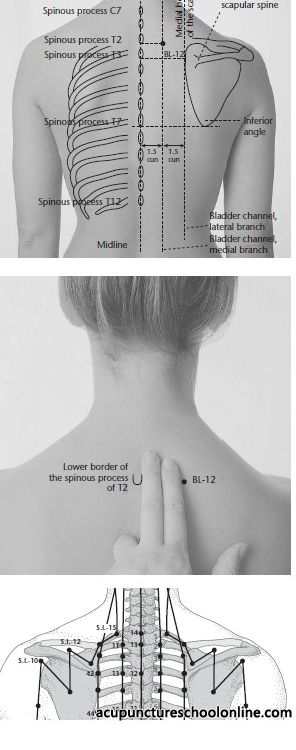
Location Guides: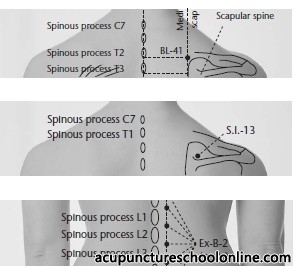 |
Master Tung's Double Phoenixes
Master Tung's Nine Monkeys
1.5 cun lateral to the lower border of the spinous process of the second thoracic vertebra (T2).
Oblique insertion towards the spine 0.5 - 1 cun, or transverse-oblique insertion 1 - 1.5 cun
Perpendicular needling or oblique needling away from the spine carries a substantial risk of causing a pneumothorax.
"The Taiyang usually has much Blood and little Qi" (Su Wen 素問 ch. 24) implying this channel should normally be bled.
"The foot Taiyang is to be pierced 5 fen deep and remain inserted for seven exhalations" (Ling Shu 靈樞 ch. 12).
"It is needled to a depth of five fen, (the needle) is retained for a duration of five exhalations, and it is moxaed with five cones" (Huangfu Mi 皇甫謐, 3rd Century, Zhenjiu Jiayi Jing 針灸甲乙經).
Expels Wind and releases the Exterior
Strengthens the Wei-Defensive Qi and firms the Exterior
Disseminates and descends Lung Qi
Benefits the nose
Superficial Innervation: Posterior cutaneous thoracic nerves from T2
Dermatome Segment: T2
Deeper Structures: Dorsal rami of spinal nerves from T2
This point causes great damage both physically, mentally and to Qi. Qi circulation is immediately impaired and can take some time to readjust, opening the spine to External Wind Invasion causing them to get cold more easily and be unable to shake them. Like Dazhu Bl-11, it will also disrupt communication with the Shen causing them to change emotionally and socially over a number of years (Montaigue, Dim Mak Locations, Taijiworld.com).
In Master Tung's system a line of points corresponding to the inner back Shu points from T2 to T8, known as the double phoenix points (Shuang Feng), can be pricked to release a drop of blood in cases of pain or numbness in the extremities or arteriosclerosis.
They all relate to the Fire element and the Heart and so have the function of quickening the Blood in the Heart and the extremities (McCann, 2014, Pricking the Vessels).
This point is also one of the Nine Monkeys (Jiu Hou) in Tung Lineage acupuncture. They are located at 1.5 cun and 3 cun lateral from the midline level with T2, T3 and T4 and 6 cun from the midline, level with T1, T2 and T3. They are pricked to bleed in cases of scarlet fever and phlegm stuck in the bronchia that cannot be expelled (McCann, 2014, Pricking the Vessels).
In Tibetan medicine:
Moxa point (AMNH, Tibetan Medical Paintings)
Basic information on location, needle depth, TCM actions, indications and combinations is taken from Deadman et al (2001): A Manual of Acupuncture with additional anatomical information researched by reference to Gray's Anatomy (38th Ed., 1995) unless otherwise referenced. Images were found on acupunctureschoolonline.com and can be traced back to Claudia Focks (2008) Atlas of Acupuncture originally. I cannot claim any credit or rights over them. Other sources should be quoted in the text.
For some of the more unusual terms I have created a glossary here
Woodley Bioenergetics
90 Deane Croft Road,
Eascote, Pinner, Greater London. HA5 1SP
Tel/WhatsApp: +44 (0) 7946 174 829
Email: steve@steve-woodley.co.uk