 |
Location Guides: |
Luo-Connecting point of the Ren Mai
Master Tung's Stomach Hair Seven
Binding point of the hand Jueyin Sinews
Meeting of Conception Vessel with Strength line (Zhuangli Xian 壯力線) and Uterus Vessel (Bao Mai 胞脉)
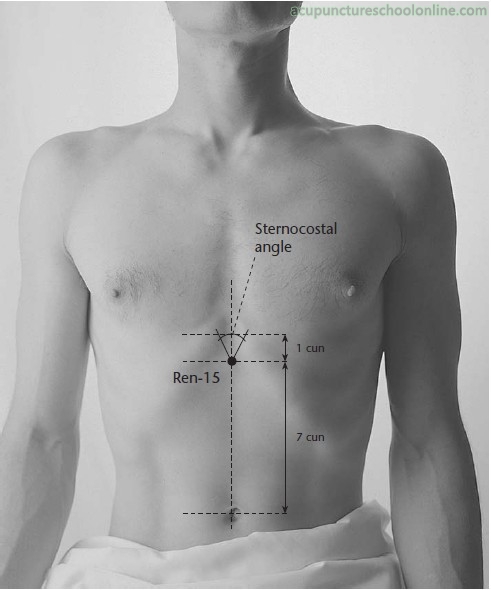
On the midline of the abdomen, 7 cun above the umbilicus and 1 cun below the sternocostal angle.
Oblique insertion directed inferiorly 0.5 - 1 cun
According to several classical texts this point is contraindicated to moxibustion. Deep insertion, especially in thin subjects, may damage the left lobe of the liver or the heart if either are enlarged. Oblique superior insertion towards the heart is contraindicated in all cases. No perpendicular needling in advanced pregnancy.
"Both needling and moxibustion are prohibited" (Huangfu Mi 皇甫謐, 3rd Century, Zhenjiu Jiayi Jing 針灸甲乙經).
Regulates the Heart and calms the Shen
Descends Lung Qi and unbinds the chest
Superficial Innervation: Anterior cutaneous thoracic nerve from T6
Dermatome Segment: T6
In seizing martial arts (Qin Na) this point is a breath sealing point (Bi Qi, 閉氣). It is struck with the wrist, palm or fist causing the muscles around the lung to contract and seal the breath, or a potential heart attack (Yang, 1995, Tai Chi Chin Na; Yang, 2004, Analysis of Shaolin Chin Na, 2nd Edition).
One of the 36 vital points of Feng Yiyuan 馮一元 listed in the Wu Bei Zhi 武備志 (Treatise on Armament Technology) by Mao Yuanyi 茅元儀 (1621). Also listed in Article 21: Delayed Death Touches with Twelve-Hour (Shichen 時辰) Diagrams.This point along with Taixi Kid-3, Kunlun Bl-60 and Baihui Du-20 it is associated with Si 巳 Snake (9-11 am) and causes death within 3 years and if struck during this time is said to cause death within 3 days from trauma to the tip of the xiphoid process (McCarthy, 2016, Bubishi: The Classic Manual of Combat).
See Montaigue, Dim Mak Locations, Taijiworld.com for explanation of effects.
Trigrams: Qian (Heaven) below, Kun (Earth) above.
Heaven within, Earth without — the light rises and the heavy sinks, so they meet in the middle. This is the perfect harmony of yin and yang, the moment of peace.
Nuclear Trigrams: Lines 2-3-4 form Dui (Lake). Lines 3-4-5 form Zhen (Thunder). Beneath the peace, there is joy (Dui) and movement (Zhen). The hidden message: peace is not static. It is alive with joy and activity.
Judgement:
小往大來,吉亨。
The small departs. The great arrives. Auspicious opening.
As the Luo point of the Ren Mai, opening this point can be beneficial by diverting Xie Qi (the small) into the Luo and allowing Zheng Qi (the great) to flow and flourish.
Overall: Peace is the moment when the creative and the receptive meet. The small departs, the great arrives. This is the time of flourishing, of success, of the marriage of Heaven and Earth.
Lines:
| Line | Yin/Yang | Image | Literal Translation | Clinical Reading |
|---|---|---|---|---|
| 1 | Yang | 拔茅茹,以其彙,征吉 | Pulling up Mao grass, in clumps. A campaign is auspicious. | Bai Mao is noted by Ge Hong for its ability to repel ghosts. This line implies that it is good to attack malevolent spiritual forces early at this point. |
| 2 | Yang | 包荒,用馮河,不遐遺,朋亡,得尚于中行 | Embrace the wild, wade across the river. Avoid neglecting the distant, or friends will perish. Obtain honour from the middle path. | There is danger but it can be averted by embracing treatment using simple crude techniques. Pay attention to where the Xie Qi came from, as the Ren Mai connects with many channels, and contains many Front-Mu points, and this Luo often fills when others fail. A combination of tonification and draining is beneficial. |
| 3 | Yang | 無平不陂,無往不復。艱貞無咎。勿恤其孚,于食有福 | There is no plain that does not become a slope; no going that does not return. Burning through hardships brings no trouble. Do not worry about the captive. In food there is blessing. | The Luo is failing to contain Xie Qi and difficulty will arise. Moxa can successfully avert trouble, specifically by nourishing the Zheng Qi to reinforce its ability to contain. |
| 4 | Yin | 翩翩,不富以其鄰,不戒以孚 | Fluttering, fluttering. Not wealthy by means of the neighbours. Not warned but with captives. | The Ren Mai is systemically involved and the relative health of its connecting channels and organs is of no help. The Xie Qi has invaded and, as the Sea of Yin, and the receptive, it has embraced it without mounting a defence. |
| 5 | Yin | 帝乙歸妹,以祉元吉 | The emperor Yi marries a maiden. With blessings, it is supremely auspicious. | It is necessary for the receptive Yin nature of the Ren Mai (the maiden) to be paired with the vigorous, ruling might of the Du Mai (the emperor Yi) to eject Xie Qi that is rampant in the Ren Mai. If this can be done, and Yuan Qi is activated to course through the Lesser Heavenly Orbit, then it will be correct. |
| 6 | Yin | 城復于隍,勿用師。自邑告命,貞吝 | The wall falls back into the moat. Do not use the army. Proclaim the command from your own city. Burning brings regret. | Yin (structure, the walls) is depleted and without it,Yang (the army) departs, allowing the Ren Mai to be overrun. All that is left is to save whatever is left, but this must come from within. The time for reinforcing with moxa has passed and may even damage Yin further with heat. |
Image:
天地交,泰。后以財成天地之道,輔相天地之宜,以左右民。
Heaven and Earth unite: Tai. Thus the ruler divides and completes the way of Heaven and Earth, assists and supports the suitability of Heaven and Earth, and thereby guides the people.
The image is of Heaven and Earth meeting — the creative and the receptive in harmony. The ruler divides and completes the way of Heaven and Earth. He does not impose his own order; he assists the natural order.
Acupuncture Point Connections:
This point is unusual in that no other point in the standard sequence shares this hexagram. Its complementary opposite is ䷋ which is attributed to the Luo of the Du Mai, Changqiang Du-1. A connection between these two points is referred to as the Bao Mai, Uterus Vessel, described in Su Wen ch. 47 (see note below).
Among the rising and falling hexagram sequence, it shares the same hexagram as Xuanshu Du-5 or Zhongshu Du-7.
Hexagram attributions are my own with an explanation given in the glossary.
Translations are my own, assisted by DSeek and compared to Richard Rutt's interpretion (2002).
The Strength line (Zhuangli Xian 壯力線) is an internal line used in inner cultivation arts (Neigong Shu 內功術) that connects the xiphoid process at this point or Zhongting Ren-16 with T11 at Jizhong Du-6 or Zhongshu Du-7. It is used to strengthen the tendons in the body and used more in the hard, external forms of Qigong and martial arts (Wang, 2019, Daoist Internal Mastery ).
One of the points in the Internal Dragons protocol in five element acupuncture is located 1/4" inch below this point, along with Tianshu St-25, Futu St-32 and Jiexi St-41, for eliminating a blockage between the therapist and patient, or a disconnection from themselves, due to internal causes.
Ling Shu Ch. 1, On the Nine Needles and the Twelve Origins, describes this point as the origin of the 膏 Gao. Unschuld translates this as "Fatty Membrane" but it generally referred to the fatty point at the tip of the heart.
Ling Shu Ch. 10 describes the diseases relating to the Luo emanating from this point as:
Repletion: Abdominal skin aches
Depletion: Itching
(Unschuld, 2016).
Also from Yuen's school, this point along with Changqiang Du-1, as the Luo points relating the Jing level of emotion, are the activation points for the Po and used in treatments relating to the levels of manifestation of the soul.
Berardinis & Navarra (2017). The succession of Po in the ladder of life. https://www.acupuncturesida.com/The-succession-of-Po-in-the-ladder-of-life.aspx
The top point of Tung's Stomach Hair Seven (Wei Mao Qi) is located at the tip of the xiphoid process, equivalent to this point's location, with two below it at 1 cun intervals. Two more are located 1.5 cun lateral to the inferior two on either side. They are treated using Tung's method of pricking for "wool-like furuncles", stomach diseases, stomach bleeding, enteritis, palpitations and various types of sudden turmoil (McCann, 2014, Pricking the Vessels).
The Uterus Vessel Bao Mai connects the Heart to the Uterus explaining emotional effects on menstruation. It runs from this point to Changqiang Du-1. The Sun Wen, ch. 47 says: "the Uterus Vessel pertains to the Heart and extends to the Uterus... When the period does not come it means the Uterus Vessel is obstructed".
Lad and Durve (2008) in Marma Points of Ayurveda call this point Agra Patra and associate it with the doshas: Prana Vayu, Udana Vayu, Vyana Vayu, Pachaka Pitta and Sadhaka Pitta.
They give the following functions:
- Regulates cardiac function and heart rate
- Enhances lung functions
- Relieves pain locally
- Releases suppressed emotions
In Tibetan medicine:
Moxa point (AMNH, Tibetan Medical Paintings)
Basic information on location, needle depth, TCM actions, indications and combinations is taken from Deadman et al (2001): A Manual of Acupuncture with additional anatomical information researched by reference to Gray's Anatomy (38th Ed., 1995) unless otherwise referenced. Images were found on acupunctureschoolonline.com and can be traced back to Claudia Focks (2008) Atlas of Acupuncture originally. I cannot claim any credit or rights over them. Other sources should be quoted in the text.
For some of the more unusual terms I have created a glossary here
Woodley Bioenergetics
90 Deane Croft Road,
Eascote, Pinner, Greater London. HA5 1SP
Tel/WhatsApp: +44 (0) 7946 174 829
Email: steve@steve-woodley.co.uk