 |
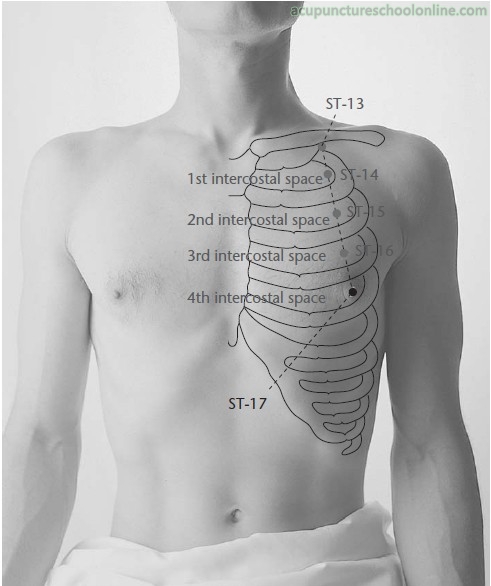
Location Guides: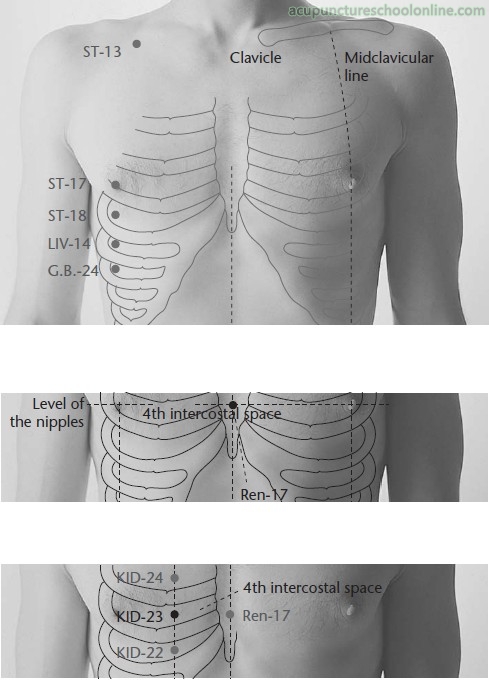 |
 |
Xu Qiufu Ghost point
The breasts are also binding points of the foot Shaoyang Sinews
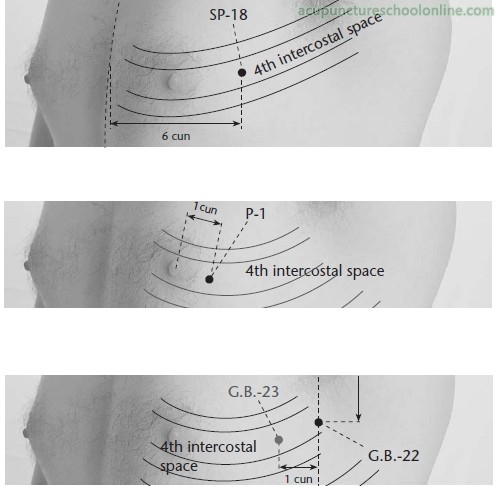
At the centre of the nipple, in the fourth intercostal space, 4 cun lateral to the midline.
Reference point only
This point is contraindicated to both needling and moxibustion, and is used simple as a reference point
"The Yangming usually has much Qi and much Blood" (Su Wen 素問 ch. 24) implying this channel can normally be needled or bled.
"The foot Yangming is to be pierced 6 fen deep and remain inserted for ten exhalations" (Ling Shu 靈樞 ch. 12).
"If" (this point is) moxaed or needled, there will be the unfortunate development of corroding sores. Breast sores with pus, blood, and serum are curable. Breast sores with polyps looking like the corroding sore are fatal" (Huangfu Mi 皇甫謐, 3rd Century, Zhenjiu Jiayi Jing 針灸甲乙經).
None. Reference point only.
Superficial Innervation: Cutaneous branches of thoracic nerves from T5
Dermatome Segment: T5
This point has a devastating effect when struck and can cause death with a medium to hard strike if accurate to within a millimetre. Immediately there is a sensation
moving up the same side of the neck and over the top of the back of the head to the other side of the forehead, followed by an extreme Qi drainage resulting in knockout and loss of memory. If the strike has been hard enough, it could also result in mental illness which gets worse with age (Montaigue, Dim Mak Locations, Taijiworld.com).
In seizing martial arts (Qin Na) this point is a breath sealing point (Bi Qi, 閉氣). It is struck with an palm, fist or Phoenix Eye Fist causing the lung to contract and seal the breath (Yang, 1995, Tai Chi Chin Na; Yang, 2004, Analysis of Shaolin Chin Na, 2nd Edition).
In contradiction to the general rule of avoiding treatment at this point Ge Hong (4th century) advises burning three cones of moxa on each nipple along with seven on the clump of hair at the base of the big toe for Dian Kuang with falling fits and manic frenzy (Strickmann, M, 2002, Chinese Magical Medicine, p. 240, Stanford University Press).
The Stomach Shu are a proposed set of points that complement the Breast Shu. They are level with the Chest Shu and Front Mu points on the abdomen and receive the Blood and Ying Qi created through the action of the Spleen and Lung, via the Breast Shu, to distribute among the Zangfu. Whereas the Back Shu and Chest Shu deliver Yang and Yin Yuan Qi through the Bladder and Kidney Channels to the Zangfu, these points are focused specifically on postnatal Qi.
This point would be associated with the Spleen. It is unusual for having no indications but this is because it is the Spleen that provides the Qi for these points and its main function in this instance is in childbirth providing milk for the infant.
Piercing increases the sensitivity and size of the nipple and can reverse inversion of the nipple.
Sometimes pierced in tribal cultures including the Karakawa indians of Texas and the women of the nomadic Kabyle tribe of Algeria.
In Europe piercing the nipple has been recorded as a fashion statement dating back to the 14th century when necklines dropped so low the nipples were showing and jewellery would be worn for fashion.
This died out and nipple piercing enjoyed a brief resurgence of interest among society women in the 1890s as a sexual enhancement before disappearing again and arriving more openly in the 1970s among the gay BDSM cultures before becoming popularised by several celebrities enabling it to enter the mainstream (Morrison, 1998: Piercing History, Painful Pleasures)
Lad and Durve (2008) in Marma Points of Ayurveda call this point Stanya or Chuchuka and associate it with the doshas: Vyana Vayu, Apana Vayu, Prana Vayu and Avalambaka Kapha.
They give the following functions:
- Regulates lactation
- Stimulates uterine contractions during childbirth
Basic information on location, needle depth, TCM actions, indications and combinations is taken from Deadman et al (2001): A Manual of Acupuncture with additional anatomical information researched by reference to Gray's Anatomy (38th Ed., 1995) unless otherwise referenced. Images were found on acupunctureschoolonline.com and can be traced back to Claudia Focks (2008) Atlas of Acupuncture originally. I cannot claim any credit or rights over them. Other sources should be quoted in the text.
For some of the more unusual terms I have created a glossary here
Woodley Bioenergetics
90 Deane Croft Road,
Eascote, Pinner, Greater London. HA5 1SP
Tel/WhatsApp: +44 (0) 7946 174 829
Email: steve@steve-woodley.co.uk