 |
Location Guides: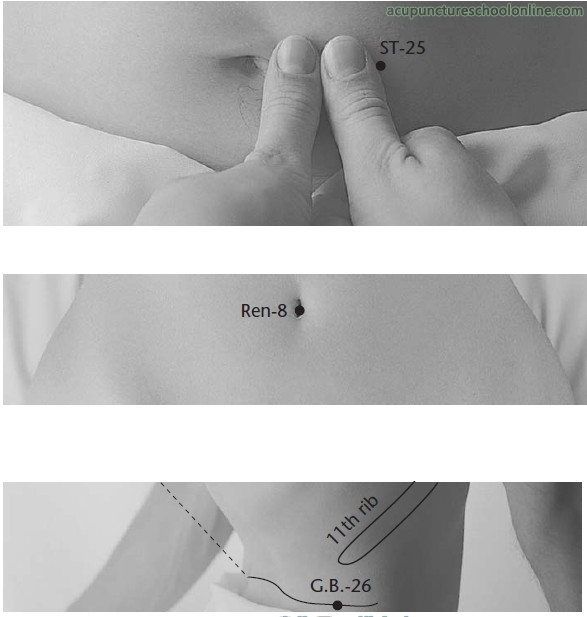 |
 |
Front Mu of the Large Intestine
Shokanten Nine Continents Point of the Middle Jiao, Shaoyang and eyes and ears
Master Tung's Bowel Nest Twenty-Three
Meeting of Stomach with Large Intestine Divergent and Lung Divergent
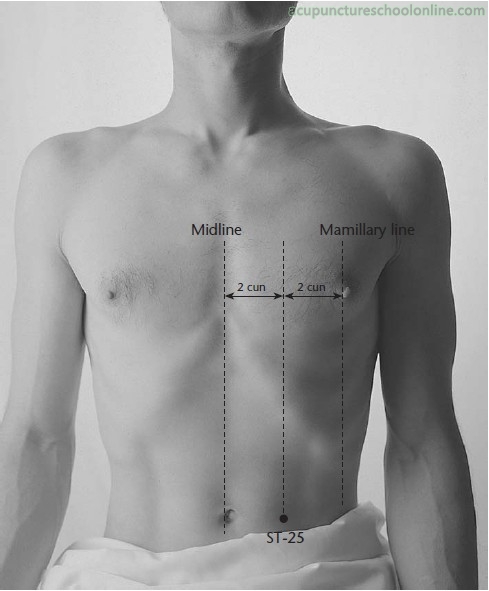
On the abdomen, 2 cun lateral to the umbilicus.
Perpendicular insertion 1 - 1.5 cun
Oblique inferior insertion towards the uterus for diseases of the uterus
In thin subjects, deep needling may penetrate the peritoneal cavity
"The Yangming usually has much Qi and much Blood" (Su Wen 素問 ch. 24) implying this channel can normally be needled or bled.
"The foot Yangming is to be pierced 6 fen deep and remain inserted for ten exhalations" (Ling Shu 靈樞 ch. 12).
"It is needled to a depth of five fen, (the needle) is retained for a duration of seven exhalations, and it is moxaed with three cones" (Huangfu Mi 皇甫謐, 3rd Century, Zhenjiu Jiayi Jing 針灸甲乙經).
Regulates the Intestines
Regulates the Spleen and Stomach
Resolves Dampness and Damp-heat
Regulates Qi and Blood and eliminates stagnation
Regulates the Middle Jiao (Nan Jing 31)
Superficial Innervation: Cutaneous branches of thoracic nerves from T10
Dermatome Segment: T10
Listed in the Wu Bei Zhi 武備志 (Treatise on Armament Technology) by Mao Yuanyi 茅元儀 (1621), Article 9: Twelve-Hour (Shichen 時辰) Vital Points Revealed as the vital point associated with the Chen 辰 Dragon (7 - 9 am) and the Stomach meridian (McCarthy, 2016, Bubishi: The Classic Manual of Combat).
As a Mu point for the colon, a strike here will affect the bowels. It is on the border of protection by the upper abdominals and the relative lack of protection below the navel. It can cause knock out and diarrhoea on the spot when struck hard. As the Shokanten point of the Shaoyang is capable of disrupting the communication between the Shen and Shaoyang Fu Organs causing emotional disorders and the physical symptoms that go with them. This will cause the recipient to feel pain that will grow in a circle outward from the strike, then a great feeling of power loss (Montaigue, Dim Mak Locations, Taijiworld.com).
In seizing martial arts (Qin Na) this point is a breath sealing point (Bi Qi, 閉氣). Striking this cavity may cause the lung to contract and seal the breath (Yang, 2004, Analysis of Shaolin Chin Na, 2nd Edition).
Trigrams: Dui (Lake) below, Kun (Earth) above.
Openness within, receptivity without — the lake rests upon the earth. The joyful and open is supported by the receptive and yielding. This is approach: something new is drawing near, and the ground is ready to receive it.
Nuclear Trigrams: Lines 2-3-4 form Zhen (Thunder). Lines 3-4-5 form Kun (Earth). Beneath the approach, there is movement (Zhen) and receptivity (Kun). The hidden message: the approach is alive with movement, and it is grounded in the receptive earth.
Judgement:
元亨利貞。至于八月有凶。
Supreme opening. Beneficial burning. When the eighth month comes, it is inauspicious.
This point can access the Yuan level, due to the Large Intestine's relationship with the Kidneys (5 - 7 am and pm on the Zangfu Clock). It can be used to regulate, or be tonified with moxa. The arrival of Cold (the eighth month) is often harmful.
Overall: Something new is approaching. The yang is rising. This is a time of growth and opportunity. But the cycle will turn. The eighth month will come. Do not become attached to the approach as if it will last forever.
Lines:
| Line | Yin/Yang | Image | Literal Translation | Clinical Reading |
|---|---|---|---|---|
| 1 | Yang | 咸臨,貞吉 | Approaching with influence. Burning is auspicious. | Xie Qi arrives. Even at its beginning, it has influence due to this Fu usually receiving established pathogens from other sources. Moxa is auspicious because it can strengthen the Wei Qi to fight the Xie Qi here before it begins to have an effect. |
| 2 | Yang | 咸臨,吉無不利 | Approaching with influence. Auspicious. Nothing is unfavourable. | The Xie Qi is taking hold, but the situation is much the same as before. Treatment of any kind is appropriate here, depending on whether the presentation is of Cold or Heat. |
| 3 | Yin | 甘臨,無悠利。既憂之,無咎 | Sweet approach. Nothing is beneficial. If one is anxious about it, no trouble. | The Xie Qi has been allowed in. Nothing is beneficial because it is already escaping the confines of the point and is entering the Organ, but if this is recognised and treated early at this level, trouble can be avoided. |
| 4 | Yin | 至臨,無咎 | Arriving approach. No trouble. | Similar to the previous statement, except that it is now clear the Xie Qi has entered the Organ. For this reason there is no statement about anxiety, since the situation is clear, but there need not be trouble as it has not yet taken a firm hold. |
| 5 | Yin | 知臨,大君之宜,吉 | Knowing approach. The great prince is appropriate. Auspicious. | The approach of the Xie Qi is well known as the Large Intestine is clearly affected. Treatment will be successful providing that appropriate and decisive measures are taken (i.e. purgation). |
| 6 | Yin | 敦臨,吉無咎 | Pressing approach. Auspicious. No trouble. | The Xie Qi is gathering in the Large Intestine, but the omen is positive. This may be because the Large Intestine's main function is to expel waste, so this line indicates that purgation has resolved the issue and the work of restoring lost fluids can begin. |
Image:
澤上有地,臨。君子以教思無章,容保民無疆。
The earth above the lake: Lin. Thus the gentleman teaches with inexhaustible thought and protects the people without boundary.
The earth is above the lake — the receptive is above the open. The gentleman teaches with inexhaustible thought and protects the people without boundary. Approach is not just receiving what comes. It is actively preparing the ground — teaching, protecting, making ready. The yang is approaching, but the yin must be ready to receive it.
Acupuncture Point Connections:
Shared with Zhongfu Lu-1.
Inverted into ䷓ (Daling Pc-7 or Waiguan SJ-5).
Opposed by ䷠ (Pishu Bl-20 or Weishu Bl-21).
Hexagram attributions are my own with an explanation given in the glossary.
Translations are my own, assisted by DSeek and compared to Richard Rutt's interpretion (2002).
One of the points in the Internal Dragons protocol in five element acupuncture, along with Jiuwei Ren-15, Futu St-32 and Jiexi St-41, for eliminating a blockage between the therapist and patient, or a disconnection from themselves, due to internal causes.
Classical texts such as the Nei Jing and Ling Shu which considered the Dai mai as simple a circle around the waist would include this a point on the Dai mai along with others level to Shenque Ren-8 and Mingmen Du-4 instead of the traditional points (Yuen, 2005, The Eight Extraordinary Vessels).
Tianshu 天樞 is the Chinese name for the star Dubhe in the constellation of the Big Dipper. By joining a line between this star and Merak, it acts as a pointer towards the Northern Pole Star.
Each of the stars in the Big Dipper relate to an internal organ. Tianshu is the star that corresponds to the Heart (Archangelis, Lanying, 2010, Jade Writing: Yellow Court Classic, p. 42).
If Tianshu is acting as a pointer to a central axis of the body, it would be Shenque Ren-8, at the navel. The other stars in the Big Dipper could then be theoretically determined. The most obvious group of points for this selection would be the Yin Front Mu points in the middle and upper upper body making the following attributions:
Besides some interesting connotations to the names ("Fluctuating Light" for the Lungs which fluctuate as they inhale and exhale, "Open & Positive" for the Pericardium) and attributions (Alioth, the brightest star being the point of the Heart), these seven points can represent the entire Zangfu system mapped on to the front of the body with this point standing in for the Kidneys and Lower Jiao as a whole (Large Intestine and Kidney are complementary earthly branches, representing 5-7 am/pm on the clock) while Zhongwan Ren-12 is the Hui-Meeting point of the Fu organs and so represents them all.
Support for this theory can be found in the presence of second astrologically named acupuncture point close by, Taiyi St-23 which is the Chinese name for 8 Draconis that resides close to Dubhe and between this star and Megrez (天权 Tianquan, Celestial Authority). This would place it between here and Zhongwan Ren-12 which is approximately where Taiyi St-23 is located.
A second star, Struve 1694, is also called 天樞 Tianshu and resides within the Northern Pole asterism and was the Pole Star from the Han to the Song dynasty.
This point, along with Renying St-9, Lieque Lu-7 or Taiyuan Lu-9 and Zhongwan Ren-12, is seen as symbolic of the switch to post-natal nourishment from the lungs and stomach after the infant's first breath instead of through the navel at Shenque Ren-8 pre-natally. Its role in the set is to anchor the nourishment drawn down and enable elimination (Lung/Large Intestine and Large Intestine/Stomach relation).
This set is therefore indicated for difficulty in relating to the physical, material world, implying an issue with the first Level of Manifestation of the Soul, roughly equivalent to the base or Muladhara chakra and basic consciousness, the awareness of being alive, materiality, the consolidation of Jing and transformation of Qi into Jing (Yuen, 2005, 3 Spirits & 7 Souls).
All of the points in this sequence are related to drawing the breath down to the abdomen. The inclusion of Tianshu St-25, the Front Mu of the Large Intestine, instead of any Kidney points, brings to mind the Su Wen Ch. 8 that described the Large Intestine as "transmitter of the Way".
In Sufism this level would relate to the Valley of the Quest described by Attar in the Conference of the Birds as:
"When you descend into the valley of quest
A hundred difficulties will assail you in that empire;
Here for years you must endeavour, you must try
Because in this field elements inverted lie..."
Here the mystic must set up the foundation with diligent practice and patience as they begin their spiritual journey.
The reference to inverted elements brings to mind several descriptions of inverting the process of creation (from the One to multiplicity) to reattain the original unity in Neidan texts.
It is important to include this point to a Divergent treatment where the bowels are compromised in order to make sure routes of elimination are open to facilitate evacuation the pathogen (Cecil-Sterman, 2012, Advanced Acupuncture).
This point treats disorders of the Middle Burner in a San Jiao treatment (Wang & Robertson, 2008, Applied Channel Theory).
Shokanten points are often used in Japanese acupuncture to treat conditions arising from a psycho-emotional background. This point affects the Middle Jiao, Shaoyang and the eyes and ears.
In Tung lineage acupuncture the Bowel Nest 23 (Fu Chao Er Shi San) are a group of points located in a line at 1 cun intervals between Ren-2 and Ren-10. An additional eight points on either side form a 4x5 grid at the levels of Ren-9 to Ren-5, also at 1 cun intervals. This would match with the alternative location for this point given in the Great Compendium. Ren-8, on the navel, is not included.
They are pricked using Tung's method in local disorders of pain, stagnation and heat in the abdomen such as uteritis, nephritis, umbilical area pain, enteritis, appendicitis and intestinal cancers (McCann, 2014, Pricking the Vessels).
In nine palaces abdominal acupuncture, this point is located in the region associated with ☳ Zhen, Thunder, the east and the Liver and Gallbladder organs on the right; and ☱ Dui, Lake, the west and the Lung and Large Intestine on the left (Schelbert, 2014, Ryan, 2009).
The Stomach Shu are a proposed set of points that complement the Breast Shu. They are level with the Chest Shu and Front Mu points on the abdomen and receive the Blood and Ying Qi created through the action of the Spleen and Lung, via the Breast Shu, to distribute among the Zangfu. Whereas the Back Shu and Chest Shu deliver Yang and Yin Yuan Qi through the Bladder and Kidney Channels to the Zangfu, these points are focused specifically on postnatal Qi.
This point would be associated with the Large Intestine and is unique for also being the Front-Mu point of the Large Intestine. Front-Mu points are usually used in acute diseases to facilitate draining and since the Large Intestine function is mainly expelling, supplying additional Blood and Qi to this organ assists its function and enables this point to be used in dry patterns where nourishment of the bowel is needed to support its function to expel.
In Tibetan medicine:
Moxa point (AMNH, Tibetan Medical Paintings)
The Front Mu points make likely locations for application of leeches to reduce fevers according to François Broussais' (1772-1838) philosophy who believed in placing them over the diseased organs to reduce inflammation (Greenstone, 2010, The history of bloodletting, BCMJ, Vol. 52, No. 1, Pp 12-14).
Basic information on location, needle depth, TCM actions, indications and combinations is taken from Deadman et al (2001): A Manual of Acupuncture with additional anatomical information researched by reference to Gray's Anatomy (38th Ed., 1995) unless otherwise referenced. Images were found on acupunctureschoolonline.com and can be traced back to Claudia Focks (2008) Atlas of Acupuncture originally. I cannot claim any credit or rights over them. Other sources should be quoted in the text.
For some of the more unusual terms I have created a glossary here
Woodley Bioenergetics
90 Deane Croft Road,
Eascote, Pinner, Greater London. HA5 1SP
Tel/WhatsApp: +44 (0) 7946 174 829
Email: steve@steve-woodley.co.uk